Customising relief packages

Customising relief packages

A series of eyewitness accounts from volunteers at relief camps across the country:

Pakistanis are known for their resilience.  Many young volunteers have risen and stepped out on the streets to collect donations and visit affected areas to provide relief. It’s heartening to witness the passion of these volunteers who have taken the risk to head out to affected areas without any expertise or experience. As part of the Future Leaders of Pakistan’s (FLP) flood relief efforts, I had a chance to be a part of a relief convoy this past weekend. FLP collaborated with the Rotary Club of Karachi to distribute relief packages in Thatta, Sujawal, and Sharif Solang in  Sindh.

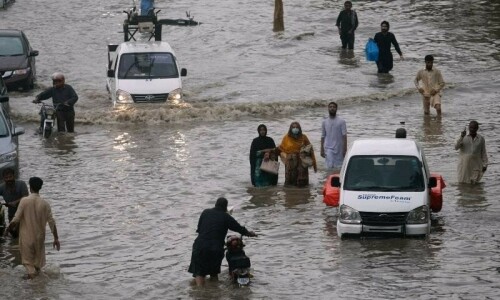
Our day began with identifying affected areas to begin distribution. Sujawal situated in Thatta district was identified as the base camp for distribution of aid. According to the District Officers, Sujawal hosts over 27,500 internally displaced families. Living in abysmal conditions most of these people were living by the roadside on charpai and temporary tents made out of mere straw. The living conditions deteriorated as we traveled further into Sujawal. Roads had been inundated at various points and families were forced to take shelter in areas where there was no electricity.  Snakes, other insects and stray dogs were rampant and the families live under a high risk of being attacked by them.

Apart from basic relief items, care packages contained hygiene packets for women and care packets for infants, which were modified to cater to the needs of families present in the area, with special addition of mosquito-killing coils, anti-septic soaps, ORS, and porridge for infants. A basic survey was carried out to collect data and to facilitate a medical team scheduled to visit the area next week.

Volunteers with a background in health services also counseled women in the Sharif Solangi camp on a special diet plan for women who were pregnant or lactating. “We have been living in this camp for a month and no doctors have come our way, so we are glad we are getting some help. Yours is the first team to come here along with females to speak to us,” said one of the women at the Solangi camp to a female FLP volunteer.

My experience in Thatta has allowed me to organise better and customised relief packages for the upcoming trips to the region. The need to modify relief hampers to cater to the needs of people from different areas in extremely essential. For instance, in Sujawal, people lacked basic utensils which is why including cooked rotis would be a better option. Although the Solangi camp was better equipped than the rest, they were in dire need of food for infants.

Perhaps the best workable solution would be to collaborate with various organisations to identify individual camps that could be adopted to provide relief and rehabilitation as a long-term strategy. The only substantial solution will be to devise a strategy that ensures proper relief and medical aid with consistency being the key factor. Efforts like these prove that there is still hope for Pakistan. As people continue to fight and help each other in these tough times, one only hopes that the rest of the world will also donate generously to help the millions affected by the floods.

Sana Saleem is a Features Editor at BEE magazine and blogs at Global Voices,  Asian Correspondent and her personal blog Mystified Justice. She recently won the Best Activist Blogger award by CIO & Google at the Pakistan Blogger Awards. She can be found on Facebook and tweets at twitter.com/sanasaleem.

The views expressed by this blogger and in the following reader comments do not necessarily reflect the views and policies of the Dawn Media Group.

Share
 

Comments Guide:
Dawn.com encourages its readers to share their views on our blogs. We try to accommodate all users' comments but this is not always possible due to space and other constraints. Please our read our comments guidelines below for more information:

1. Please be aware that the views of our bloggers and commenters do not necessarily reflect Dawn.com's policies.

2. Though comments appear to have been published immediately after posting, they are actually forwarded to a moderation queue before publication.

3. Dawn reserves the right to remove or edit comments that are posted on this blog.

4. Language that is offensive to any race, religion, ethnicity, gender or nationality is not permitted.

5. Avoid posting comments in ALL CAPS. Commenters are also encouraged to avoid text contractions like 'u r.'

6. Do not cross-post comments across multiple blog entries.

7. Any comments posted to a blog entry should be relevant to the topic or discussion.

8. Do not spam the comment section.

6 Responses to “Customising relief packages”

  1. Zaidi says:

    First of all i would like to appreciate the tremendous efforts of Pakistani youth who have come forward on their own to help flood affectees…Hats off to you guys
    Secondly Pakistan is passing through a crucial period and its our moral and ethical responsibility to come forward and help our people in this time of need

  2. Maryam says:

    Sana being a female i am glad u provided care and hygeine packets to women. me and a friend of mine who donated generously for flood victims wanted to take of this main issue. Everyone wants to provide food and water but for women this is as necessary as anything else.
    thumbs up to ur team as we were unable to do this on our own and ended up giving donations to people who were going there.

  3. Sher Zaman says:

    Collaborating with relief organizations is important because they have already identified the needs of those living in the camps; instead of randomly taking the relief stuff to the affectees, collaboration with the organizations would offer a much better solution, provided the organization’s background is fully known, because it has been reported that some militant organizations are also working in this regard.

  4. A.A.Qureshi says:

    Self-help is the main factor with locals support. just to guide and make them organize is much better. A lot of small things when you are displaced are require attention as such to safe the lives. Properly placed, water, food, cleaning yourself as well as all around. Management as such the distribution and delivery may be easy.

    Massess from cities through various institutions could participate in the work. Proper identification badgets, for everybody who is there. The educated persons from cities are more helpfull. Some students of Jamshore are working but still need support and help. Keep continue, God will help too.

  5. herry says:

    This country Pakistan should fix its priorities.

  6. MehakT says:

    As the water level recedes it is time for us to become more sensible with the aid we are sending in. It is very important for people to send in exactly what the flood victims require. Even though the spirit of Pakistani’s is commendable however a lot of aid that we are sending is going to waste.

    I think before we send in our relief goods we should talk to somebody who has had first-hand experience of going to such places like somebody from the army. Currently, from what I know a lot of people are sending in food items in the form of wheat rice etc. While these are important we need to keep in mind the supply and demand mechanism. Most of the areas that are affected were our main agricultural areas and because of the flood the supply will suffer. Ultimately it will be the lower class that will suffer as this would automatically result in price hikes. We need to think of other alternatives that can be sent locally. And like you said we can only hope that the world donates generously.

    We are a very emotional nation, however we need to think smart. Working towards their rehabilitation will not be an easy process but if we stand together we can bring them out of this state.